Korean skincare offers a uniquely intelligent and effective approach to hyperpigmentation. Whether you're battling dark spots, melasma, or stubborn post-acne marks, its philosophy is rooted in a gentle, ingredient-focused methodology. The secret lies in pairing potent brightening agents like niacinamide and vitamin C with deeply soothing, barrier-repairing compounds.
This isn't about quick fixes or harsh chemical peels. It's a strategic process of repairing the skin's natural defenses while simultaneously correcting discoloration, offering a sustainable path to a luminous, even-toned complexion.
Why K-Beauty Is Your Answer to Hyperpigmentation
If you've been on a quest to even out your skin tone, you're likely familiar with the frustrating cycle. Aggressive treatments promise dramatic results but often deliver irritation, sensitivity, and-in some cases-rebound pigmentation that's even darker than before.
This is precisely where the Korean skincare philosophy presents a more sophisticated path forward. Instead of stripping the skin with brute force, K-Beauty is dedicated to nurturing it back to optimal health.
At Mirai Skin, we are passionate advocates for this gentle-yet-powerful method. The ultimate objective isn't merely to fade existing spots, but to cultivate a resilient, healthy skin environment where new hyperpigmentation is far less likely to form. This is achieved by strategically layering hydrating and reparative ingredients with targeted brightening actives.
The Science Behind the Glow
The global demand for effective skincare is immense. Consider the South Korean hyperpigmentation treatment market alone, which grew from USD 16.6 million in 2023 and is projected to reach USD 29.2 million by 2030. This growth is fueled by the very multi-step routines and innovative ingredient formulations that define the K-Beauty landscape. You can explore the data in this hyperpigmentation treatment market analysis.
This success is built on a few core principles:
- Barrier Support First: A healthy skin barrier is your ultimate defense. K-Beauty prioritizes ingredients like ceramides and snail mucin that fortify this barrier, which in turn reduces the inflammation that can trigger pigmentation.
- Targeted, Potent Treatments: K-Beauty serums and ampoules are engineered to deliver concentrated doses of proven brightening ingredients-like Tranexamic Acid and Licorice Root-directly to the cells that need them most.
- Non-Negotiable Protection: Sunscreen is the absolute cornerstone of any Korean skincare routine for hyperpigmentation. Without daily SPF, even the most advanced brightening products cannot prevent new spots from forming. It's that critical.
By focusing on the holistic health of your skin, Korean skincare doesn't just treat hyperpigmentation-it helps you achieve a lasting, radiant glow from within. It’s a comprehensive strategy for long-term clarity and confidence.
What Is Hyperpigmentation and Why Do You Have It?
To achieve the best results from your skincare, you first need to understand the science behind what you’re seeing in the mirror. Hyperpigmentation is the clinical term for any patch of skin that appears darker than the surrounding area, but the underlying causes can vary significantly.
Think of your skin’s pigment, melanin, as a highly responsive internal security system. Under normal conditions, it produces just enough melanin to create your skin's unique tone. However, when it detects a threat-such as UV radiation, inflammation from an acne lesion, or hormonal fluctuations-it triggers an alarm.
In response, your skin's melanocytes ramp up melanin production as a protective shield. This localized overproduction is what manifests as the dark spots and uneven patches we identify as hyperpigmentation.
The Different Faces of Dark Spots
Not all dark spots are created equal. Identifying which type of hyperpigmentation you have is the most critical first step in selecting the right Korean skincare for hyperpigmentation. Each type has a distinct cause and requires a tailored approach.
Here are the most common types you’ll encounter:
-
Post-Inflammatory Hyperpigmentation (PIH): These are the brown or black marks left behind after the skin has experienced inflammation. The most common culprit is acne, but PIH can also result from a scratch, insect bite, or a reaction to a harsh product. It occurs because the inflammatory cascade signals melanocytes to go into overdrive at the site of the trauma.
-
Post-Inflammatory Erythema (PIE): Often confused with PIH, PIE appears as red or purplish marks. These spots are not caused by an overproduction of melanin. Instead, they are the result of damage to the tiny blood vessels (capillaries) near the skin's surface during an inflammatory event, like a severe pimple. PIE tends to be more prevalent in lighter skin tones.
Key Takeaway: The color of the mark provides crucial diagnostic information. Brown or black spots are PIH (a melanin issue), while red or pink spots indicate PIE (a vascular issue). Understanding this distinction is a game-changer when selecting targeted K-Beauty treatments on Mirai Skin.
Deeper and More Widespread Discoloration
While PIH and PIE are typically localized, other forms of hyperpigmentation can cover larger areas and are often linked to long-term or systemic triggers.
-
Sun Spots (Solar Lentigines): These are flat, oval-shaped brown macules that appear on sun-exposed areas like the face, hands, and shoulders. They are the direct result of cumulative UV exposure causing melanin to cluster in high concentrations over time.
-
Melasma: This type manifests as larger patches of brown or grayish-brown discoloration, typically on the cheeks, forehead, nose, and upper lip. Melasma is notoriously difficult to treat because it’s triggered by a combination of factors, including sun exposure and hormonal shifts from pregnancy or oral contraceptives.
Once you’ve correctly identified your type of hyperpigmentation, you can begin to build a routine that will deliver tangible results. The optimal Korean skincare strategy will depend on whether you're targeting melanin-driven PIH and sun spots or calming the vascular redness of PIE.
Meet the K-Beauty Ingredients That Fade Dark Spots
Building a Korean skincare routine for hyperpigmentation is like assembling a team of specialists, each with a unique mechanism of action for restoring your skin’s even tone. Instead of relying on a single, one-size-fits-all product, K-Beauty leverages a synergistic blend of "hero" ingredients. Some inhibit the initial synthesis of new pigment, while others accelerate the removal of existing discoloration.
Understanding these key players is the secret to constructing a routine that delivers visible, lasting results. Let's introduce the stars of the show.
The Antioxidant Shield: Vitamin C
Think of Vitamin C as your skin's daytime bodyguard. This powerhouse antioxidant works tirelessly to neutralize free radicals-unstable molecules from UV radiation and pollution that trigger inflammation and signal melanin overproduction. By neutralizing this initial trigger, it serves as your first line of defense against new spots.
Simultaneously, Vitamin C is a potent brightener. It inhibits the activity of an enzyme called tyrosinase, which is essential for melanin synthesis. By slowing this process, it helps fade existing sun spots and post-acne marks, leading to a more uniform complexion over time.
- Ideal Concentration: Look for formulas with 5% to 20%. If you're new to Vitamin C, start at a lower concentration (around 5%) to allow your skin to acclimate.
- Best For: All skin types, but it's a non-negotiable for tackling sun spots and general dullness. For sensitive skin, seek out gentler, stabilized derivatives like Ascorbyl Glucoside.
The Master Regulator: Niacinamide
If Vitamin C is the shield, Niacinamide (a form of Vitamin B3) is the sophisticated manager overseeing multiple cellular functions. Its primary role in treating hyperpigmentation is to act as a traffic controller for melanin. It physically inhibits the transfer of melanosomes (pigment granules) from melanocytes to the surrounding keratinocytes in the epidermis.
Essentially, even if your skin produces excess melanin, Niacinamide helps prevent it from ever becoming visible on the surface. Studies have shown it can reduce this transfer by 35-68%, making it exceptionally effective for post-inflammatory hyperpigmentation (PIH). It also fortifies the skin barrier and provides anti-inflammatory benefits, which helps prevent dark spots from forming.
K-Beauty has mastered the art of formulating with niacinamide. The global hyperpigmentation treatment market is projected to hit USD 1.46 billion in 2025, and K-Beauty products have captured a significant share with innovative niacinamide serums that can inhibit tyrosinase by 20-40%. You can learn more about this trend in this in-depth market report from Straits Research.
The Resurfacing Experts: AHAs and BHAs
Alpha Hydroxy Acids (AHAs) and Beta Hydroxy Acids (BHAs) are your resurfacing specialists. Their function is to dissolve the intercellular "glue" that binds dead, pigmented skin cells to the surface. This controlled exfoliation sloughs away these discolored cells, revealing the brighter, more even-toned skin underneath.
This is a crucial step, as excess pigment is stored within these superficial layers of the epidermis.
- AHAs (like Glycolic and Lactic Acid): These are water-soluble and work on the skin's surface. They are excellent for fading sun damage and improving skin texture.
- BHAs (like Salicylic Acid): This acid is oil-soluble, allowing it to penetrate and exfoliate within the pores. It is the gold standard for PIH from acne, as it clears congestion while also calming inflammation.
The Cell Renewal Coach: Retinoids
Consider retinoids the personal trainer for your skin cells, signaling them to behave in a younger, healthier manner. They accelerate cellular turnover, causing pigmented cells to be pushed to the surface and shed more rapidly.
They also work on a deeper level, interfering with tyrosinase activity and promoting the even dispersal of melanin granules to prevent them from clumping into a visible dark spot. K-Beauty formulations often favor gentler forms like retinal or plant-based alternatives such as bakuchiol to provide all the benefits with minimal irritation.
Pro Tip: Avoid using high-strength Vitamin C and Retinoids in the same application. The optimal strategy is Vitamin C in the morning for its antioxidant protection and your retinoid at night to support the skin's nocturnal repair cycle.
The Melanin Blockers: Tranexamic Acid, Arbutin & Licorice Root
This group works directly on the melanin production pathway, making them superstars for stubborn conditions like melasma and deep-set PIH.
- Tranexamic Acid: A rising star in K-Beauty, it blocks the inflammatory pathways that signal melanocytes to produce excess pigment, particularly those activated by UV light. It forms a powerful brightening duo when paired with Niacinamide.
- Arbutin: A gentle, plant-derived brightener that functions as a tyrosinase inhibitor. It's often referred to as a less irritating alternative to hydroquinone.
- Licorice Root Extract: Contains glabridin, another natural and gentle tyrosinase inhibitor. It also boasts potent anti-inflammatory properties, making it excellent for calming redness and preventing PIH.
Before we design a routine, let's consolidate this information into a quick-reference guide so you can easily select the right ingredient for your skin's needs.
K-Beauty Hyperpigmentation Ingredient Cheat Sheet
This table helps you compare the top players in the fight against dark spots.
| Ingredient | Primary Function | Best For | Example K-Beauty Format |
|---|---|---|---|
| Vitamin C | Antioxidant protection, inhibits pigment production. | Sun damage, overall dullness. | Serums, Ampoules |
| Niacinamide | Blocks pigment transfer, strengthens skin barrier. | Post-acne marks (PIH), uneven tone. | Essences, Serums |
| AHAs/BHAs | Exfoliates surface cells, clears pores. | Rough texture, sun spots (AHAs), acne marks (BHAs). | Toners, Essences, Masks |
| Retinoids | Speeds up cell turnover, inhibits pigment. | Stubborn spots, uneven texture, anti-aging. | Serums, Creams |
| Tranexamic Acid | Blocks melanin-triggering signals from UV/inflammation. | Melasma, stubborn PIH, sun spots. | Serums, Essences |
| Arbutin & Kojic Acid | Gently inhibits the enzyme that produces melanin. | General dark spots, sensitive skin. | Serums, Ampoules |
| Centella & Licorice | Soothes inflammation, prevents PIH from forming. | Redness-prone, acne-prone, sensitive skin. | Toners, Serums, Creams |
This guide makes it easier to mix and match ingredients, ensuring you're targeting hyperpigmentation from multiple angles for the best possible results.
This infographic breaks down the primary triggers-sun, acne, and hormones-that signal your skin to initiate excess melanin production.
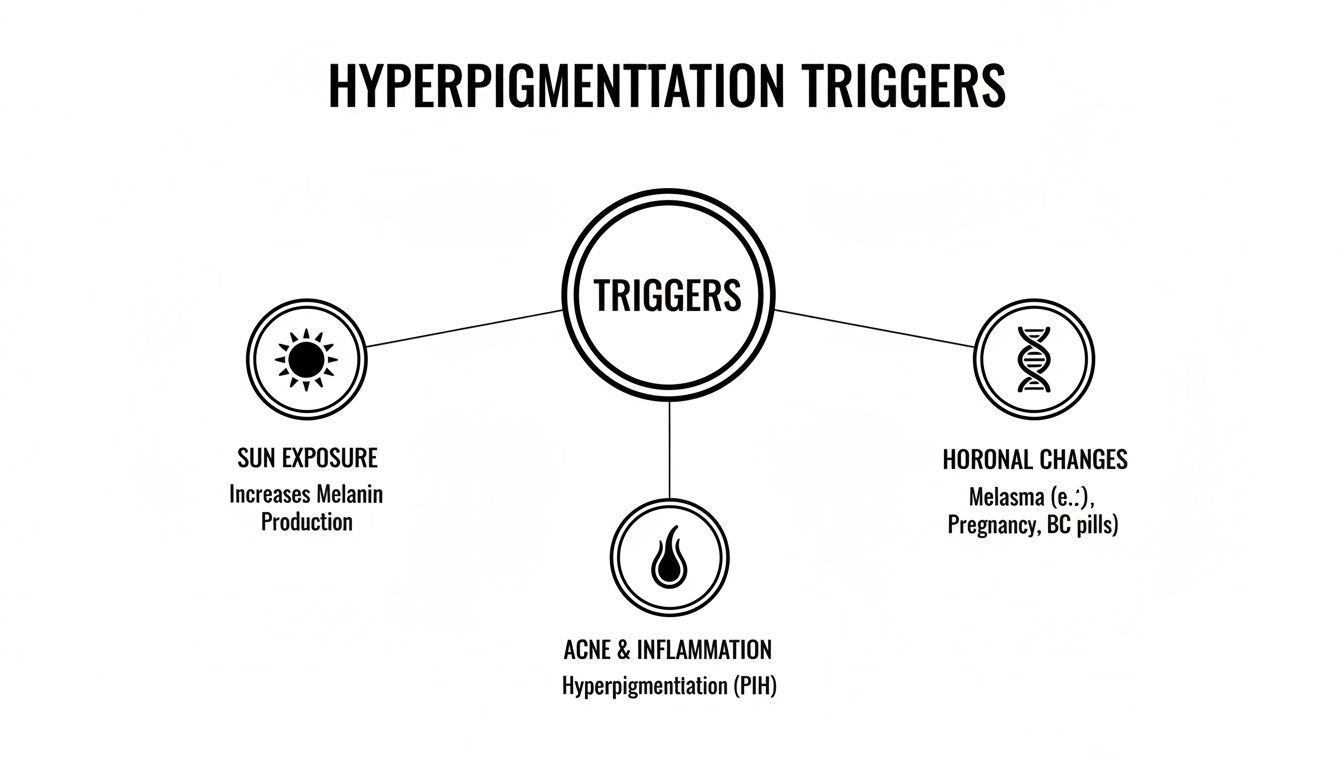
When you understand the root cause, you can select ingredients that target your specific concerns, whether that’s protecting against UV damage or calming inflammation from a breakout. By combining these hero ingredients, you can build a powerful defense against dark spots and finally achieve the clear, luminous skin you're aiming for.
How to Build Your K-Beauty Hyperpigmentation Routine
Now that you're an expert on K-Beauty's best brightening ingredients, let's translate that knowledge into a practical routine that delivers results. A successful Korean skincare for hyperpigmentation regimen isn’t about using a dozen products; it’s about intelligent, consistent layering that divides the work between your morning and evening rituals.
Your morning routine is for protection and prevention, shielding your skin from triggers that create new spots. Your evening routine is dedicated to treatment and repair, delivering the active ingredients needed to fade existing marks while you sleep.
This dual approach provides your skin with round-the-clock support. Let’s break down the optimal structure for each routine, step-by-step, with tailored options for your skin type.
Your Morning Routine for Protection
The objective of your AM routine is twofold: build an antioxidant shield and defend against UV radiation, the primary trigger for hyperpigmentation.
- Gentle Cleanse: Start with a mild, low-pH cleanser to remove nighttime products without stripping the skin. A healthy skin barrier is crucial for preventing the inflammation that leads to PIH.
- Antioxidant Serum (Vitamin C): This is your daytime MVP. A well-formulated Vitamin C serum neutralizes free radicals from UV exposure and pollution, inhibiting the melanin production cascade before it starts.
- Hydrating Moisturizer: Select a moisturizer appropriate for your skin type. Oily skin benefits from a lightweight gel, while dry skin requires a richer cream with ceramides for barrier support.
- Sunscreen (The Non-Negotiable): This is the most critical step in your routine. Without daily application of a broad-spectrum sunscreen with at least SPF 30 (SPF 50+ is optimal), all other efforts will be undermined. UV rays signal your skin to produce more melanin, darkening existing spots and creating new ones.
Every single day, regardless of weather or whether you're indoors or out-sunscreen is the anchor of your routine. It is the foundation upon which all progress is built. Neglecting sun protection is like trying to fill a bucket with a hole in it.
Your Evening Routine for Repair
Nighttime is when your skin's natural repair mechanisms are most active. Your PM routine is designed to enhance this process, delivering potent ingredients to exfoliate, resurface, and inhibit melanin synthesis while you rest.
- Double Cleanse: Begin with an oil-based cleanser to dissolve sunscreen, makeup, and sebum. Follow with a water-based cleanser to thoroughly purify the skin, creating a clean canvas for your treatment products.
- Exfoliating Toner or Essence: This step is highly customizable. Oily, acne-prone skin often responds well to a BHA (Salicylic Acid) toner that exfoliates within the pores. Dry or sensitive skin benefits from a gentle PHA or Lactic Acid essence to exfoliate the surface without irritation.
- Targeted Treatment Serum: This is your powerhouse step. Choose a serum containing ingredients like Niacinamide, Tranexamic Acid, Arbutin, or a Retinoid. These work via different pathways to block pigment, accelerate cell turnover, and fade discoloration.
- Repairing Moisturizer: Lock in your treatments with a nourishing moisturizer. Look for ingredients like Centella Asiatica or Snail Mucin to calm inflammation and support your skin barrier, creating an optimal healing environment.
Customizing for Your Skin Type
The elegance of K-Beauty lies in its adaptability. Your routine should be dynamic, responding to your skin's needs.
For example, an individual with oily, acne-prone skin might build this routine:
- AM: Gentle cleanser, Vitamin C serum, lightweight gel moisturizer, oil-free SPF 50.
- PM: Double cleanse, BHA toner, Niacinamide + Tranexamic Acid serum, calming gel cream.
Conversely, someone with dry, sensitive skin should prioritize hydration and gentle actives:
- AM: Creamy cleanser, Vitamin C derivative serum, rich ceramide cream, hydrating mineral SPF 50.
- PM: Cleansing balm and milky cleanser, PHA hydrating essence, a bakuchiol (gentle retinoid alternative) serum, and a nourishing overnight mask.
Let's organize this into a clear, side-by-side comparison.
Sample AM/PM Hyperpigmentation Routines
This template illustrates how to layer K-Beauty products to target hyperpigmentation, with specific recommendations for different skin types.
| Routine Step | Oily / Acne-Prone Skin | Dry / Sensitive Skin |
|---|---|---|
| AM Cleanse | Low-pH Foaming Cleanser | Hydrating Cream Cleanser |
| AM Treatment | 5-10% L-Ascorbic Acid (Vitamin C) Serum | Gentle Vitamin C Derivative Serum (e.g., Ascorbyl Glucoside) |
| AM Moisturizer | Lightweight Gel-Cream | Rich Cream with Ceramides and Peptides |
| AM Protection | Oil-Free, Chemical or Hybrid SPF 50+ | Hydrating Mineral Sunscreen SPF 50+ |
| PM Cleanse | Oil Cleanser + Water-Based Gel Cleanser | Cleansing Balm + Milky or Cream Cleanser |
| PM Exfoliation | BHA (Salicylic Acid) Toner (3-4x a week) | PHA or Lactic Acid Essence (2-3x a week) |
| PM Treatment | Niacinamide + Tranexamic Acid Serum | Bakuchiol or Low-Strength Retinoid Serum |
| PM Moisturizer | Soothing Gel with Centella Asiatica | Nourishing Cream with Snail Mucin or Shea Butter |
By tailoring each step, you can effectively target hyperpigmentation without compromising your skin's natural balance. This is the core principle of a successful Korean skincare for hyperpigmentation journey.
Your Guide to Long-Term Success and What to Expect
Embarking on a new hyperpigmentation routine is a commitment, and managing expectations is key to long-term success. The K-Beauty philosophy is built on consistency and nurturing skin back to health, not on aggressive, overnight transformations.
This approach requires patience. Your skin operates on its own natural renewal cycle, and effective treatment involves working with this rhythm, not against it. Setting realistic expectations from the beginning will keep you motivated and prevent the frustration that leads many to abandon their efforts prematurely.
Setting a Realistic Timeline for Results
While instant gratification is appealing, fading hyperpigmentation is a gradual process. The active ingredients in your K-Beauty routine are working at a cellular level long before you see dramatic changes in the mirror.
Here’s a practical timeline of what to expect:
- 4-6 Weeks: You should observe initial improvements in skin texture and hydration. Your overall complexion may appear brighter, and more superficial spots might begin to lighten.
- 3-6 Months: This is the timeframe for significant results. With consistent use of your targeted serums and-most importantly-daily sunscreen, you should see a noticeable reduction in stubborn dark spots and melasma.
- 6+ Months: Continued adherence to your routine will help maintain your results and prevent new spots from forming. By this stage, your skin barrier will be stronger and more resilient, contributing to overall skin health.
The Golden Rule: Patch Testing
Before incorporating any new product into your routine, patch testing is non-negotiable. The last thing you want is for a promising new serum to cause an inflammatory reaction, which can lead to more post-inflammatory hyperpigmentation (PIH) and set your progress back by weeks.
Here's how to patch test correctly:
- Apply a small amount of the product to a discreet area of skin, such as behind the ear or on the inner wrist.
- Wait 24-48 hours and monitor for any signs of redness, itching, or irritation.
- If your skin remains calm and clear, you can proceed. Introduce the product into your routine gradually, starting with 2-3 times per week to allow your skin to acclimate.
Troubleshooting Common Hurdles
Even with a well-designed routine, you may encounter challenges. Here’s how to navigate common issues without derailing your progress.
Mirai Skin Insight: Remember, consistency beats intensity every time. If your skin feels irritated, it's a signal to pull back, not push harder. A compromised skin barrier cannot heal discoloration effectively.
"My Skin Feels Irritated or Sensitive"
This is almost always a sign that you've introduced too many active ingredients too quickly. Pare your routine back to the essentials: a gentle cleanser, a calming moisturizer, and sunscreen. Once your skin has stabilized, slowly reintroduce your treatment products one by one, with several days in between each new addition.
"I'm Not Seeing Any Changes"
If you've been consistent for over three months and feel you've hit a plateau, it's time to troubleshoot. The first question to ask is: are you using sunscreen every single day, without fail? This is the most common reason for a lack of results. If your SPF application is diligent, you might then consider if the active ingredients you're using are the optimal match for your specific type of hyperpigmentation.
Your K-Beauty Hyperpigmentation Questions Answered
Diving into the world of Korean skincare for hyperpigmentation is exciting, but it often comes with a host of questions. As you build your routine, it's natural to wonder about timelines, ingredient pairings, and which steps are truly essential.
We've compiled the most common questions our community at Mirai Skin asks to provide you with clarity and confidence on your journey toward an even-toned complexion.
How Long Until I See Real Results?
This is the most frequent question, and the honest answer is that it requires patience and consistency. You will likely notice your skin feeling more hydrated and appearing brighter within the first 4 to 8 weeks.
However, for stubborn, deep-set dark spots and melasma, you should commit to a consistent routine for 3 to 6 months to see significant fading. The timeline is influenced by the depth of the pigment, the potency of your chosen ingredients, and-most critically-your unwavering dedication to daily sunscreen application.
Can I Use Vitamin C and Retinol Together?
It's best to allow these two powerhouses to work independently. Using them in separate routines maximizes their efficacy while minimizing the risk of irritation. Both are highly potent, and layering them can sometimes overwhelm the skin barrier, leading to redness and sensitivity.
The most effective strategy is to separate them:
- Morning: Apply your Vitamin C serum. Its antioxidant properties help protect your skin from environmental aggressors like UV rays and pollution throughout the day.
- Evening: Use your retinol product at night. This is when your skin is in its natural repair and regeneration mode, and retinol works synergistically with this process to accelerate cell turnover. Since it can increase photosensitivity, nighttime application is ideal.
Is the 10-Step K-Beauty Routine Necessary?
Not at all. The famous 10-step routine is more of a philosophical framework for customization than a rigid protocol. For targeting hyperpigmentation, a focused, consistent routine will always outperform an overly complex one.
An effective core routine can be streamlined to just four essential steps:
- A gentle, low-pH cleanser.
- A targeted treatment serum (e.g., niacinamide, tranexamic acid).
- A moisturizer that supports your skin barrier.
- A high-protection, broad-spectrum sunscreen.
You can certainly incorporate additional steps like an essence or an occasional wash-off mask if you enjoy the ritual, but this simple framework is all you truly need to achieve excellent results.
What Is the Most Important Product for Prevention?
If you take only one piece of information from this guide, let it be this: sunscreen. It is unequivocally the single most critical product in any Korean skincare for hyperpigmentation routine. Daily, non-negotiable application of a broad-spectrum formula with at least SPF 30 (though SPF 50+ is superior) is paramount.
UV exposure is the primary trigger for melanogenesis. It not only creates new spots but also darkens existing ones, effectively negating the benefits of your treatment products. This holds true every day, regardless of weather, and even when indoors near windows.
The market data supports this. The global demand for hyperpigmentation treatments is surging, with the market for K-beauty dark spot correctors projected to grow at an 8.9% CAGR from 2025-2035. Melasma, which accounted for 32.1% of the market in 2024, is a major concern that responds exceptionally well to K-beauty's gentle-yet-effective approach. You can find more on this trend in this Future Market Insights report.
Ultimately, consider sunscreen the insurance policy for your skincare investment. It protects your progress and is your most powerful defense against future damage.
At Mirai Skin, we are dedicated to bringing you 100% authentic Korean skincare products to help you achieve your skin goals. Explore our curated collection of serums, essences, and sunscreens, all expertly selected to combat hyperpigmentation and reveal your most radiant skin.
Shop our expert-picked hyperpigmentation solutions at Mirai Skin