Best Korean Toners for Every Skin Type (2026 Guide)
Finding the best Korean toner isn’t about chasing a single "holy grail" product. It’s about understanding your skin on a deeper level and selecting the right formula to match its unique needs. This guide is designed to help you decode labels, understand key ingredients, and choose a toner-whether hydrating, exfoliating, or calming-that will deliver tangible results.
Your Search for the Best Korean Toner Starts Here
First, let's dispel a common myth: Korean toners are nothing like the harsh, alcohol-spiked astringents of the past. The kind that left skin feeling tight, stripped, and desperate for moisture. K-Beauty completely revolutionized this skincare step, transforming it from a mere cleansing afterthought into a vital layer of hydration and targeted treatment.
Instead of stripping moisture, their primary function is to replenish it. They soften and prep your skin, creating the perfect damp canvas so that the serums and moisturizers you apply afterward can penetrate more effectively. This simple but profound shift in philosophy is why the best Korean toners have built such a massive global following among discerning skincare enthusiasts.
The demand for these gentle, effective formulas is a key driver of K-Beauty's explosive growth. The global K-Beauty market was valued at around USD 14.69 billion and is projected to more than double to about USD 31.82 billion by 2033. This reflects a massive embrace of this skin-first approach. For a deeper dive, you can find more details on this growth in market insights from dataintelo.com.
Understanding the Main Toner Categories
To find your perfect match, you first need to understand the key players. Korean toners generally fall into a few main categories, each formulated with specific ingredients to tackle different goals, from quenching parched skin to refining texture.
Think of your toner as the foundational step that sets the tone for your entire routine. A hydrating toner is like a surge of moisture for your skin post-cleanse. An exfoliating one acts as a gentle polish, clearing away dead cells for improved radiance. Selecting the right one is the first critical step toward achieving your skin goals.
Key Takeaway: The "best" toner is entirely personal. It’s the one that directly targets your primary skin concerns-whether that's dehydration, dullness, irritation, or texture.
Let's break down the most common toner types you'll find here at Mirai Skin to help you differentiate them clearly.
This table gives you a quick snapshot of what each toner category is designed to do.
Quick Guide to Korean Toner Types
| Toner Type | Primary Function | Key Ingredients | Best For Skin Types |
|---|---|---|---|
| Hydrating Toner | Deeply moisturizes, plumps skin, and supports the skin barrier. | Hyaluronic Acid, Beta-Glucan, Glycerin, Panthenol | Dry, Dehydrated, Combination, Sensitive |
| Exfoliating Toner | Removes dead skin cells, refines texture, and unclogs pores. | AHA (Glycolic Acid), BHA (Salicylic Acid), PHA | Oily, Acne-Prone, Textured, Dull |
| Calming/Soothing Toner | Reduces redness, soothes irritation, and repairs the skin barrier. | Centella Asiatica (Cica), Heartleaf, Mugwort | Sensitive, Irritated, Redness-Prone |
| Brightening Toner | Fades dark spots, evens out skin tone, and boosts radiance. | Niacinamide, Rice Extract, Vitamin C Derivatives | Dull, Uneven Tone, Hyperpigmentation |
Each type offers a distinct path for your skincare routine. Now that you have a high-level view, we can dive deeper into the science and philosophy that make each one so effective.
Why Korean Toners Are Different
To truly appreciate what makes the best Korean toners so special, you have to look beyond the ingredient list and embrace the overarching K-Beauty philosophy. In the West, many grew up with toners that were harsh, alcohol-heavy astringents designed to strip away every last trace of oil, leaving skin “squeaky clean”-a sensation we now recognize as a sign of a compromised skin barrier.
Korean skincare culture, conversely, is built on a "skin-first" foundation of gentle care, deep hydration, and long-term skin health, rather than aggressive, quick fixes. This is why Korean toners evolved from a harsh final cleansing step into a sophisticated, multi-purpose treatment that replenishes moisture instead of stripping it away.
From Cleansing Afterthought to Hydration Hero
The Korean approach views the moment right after cleansing as a golden opportunity. Instead of further stripping the skin, the goal is to immediately flood it with hydration, prepping it to absorb the potent serums and treatments that follow. A well-formulated toner essentially acts like a damp sponge, softening the stratum corneum to enhance the bioavailability of subsequent products.
This philosophy drove the creation of formulas that are aqueous yet have a satisfying slip, are packed with humectants, and are free of drying alcohols. They’re designed not just to hydrate, but to soothe, balance, and deliver active ingredients right from the start.
The Pursuit of "Chok Chok" Skin
The cultural obsession with achieving "Chok Chok"-skin so dewy, plump, and bouncy with moisture it resembles glass-is a primary driver of toner innovation. This coveted glow isn't achieved with makeup; it's the result of meticulously layered hydration. To attain this look, skincare aficionados needed products that could be applied in multiple layers without feeling heavy or sticky.
This drive for a radiant, glass-like finish pushed formulators to create lightweight yet powerful toners. These products deliver intense hydration that builds with each application, forming the foundation of that signature K-Beauty glow.
This led to techniques like the renowned "7-Skin Method," where one pats seven thin layers of a hydrating toner into the skin consecutively. This would be unthinkable with a traditional Western toner, but it’s a cornerstone of K-Beauty, designed to saturate the skin with moisture from the inside out.
A Focus on Barrier Support and Gentle Actives
Finally, Korean toners are different because they respect the skin's natural barrier. Instead of relying on high concentrations of aggressive ingredients, K-Beauty toners are often formulated with skin-soothing botanicals and barrier-fortifying compounds.
- Soothing Botanicals: You’ll almost always find ingredients like Centella Asiatica, Heartleaf, and Mugwort. They are staples for their remarkable ability to calm redness and mitigate irritation.
- Fermented Ingredients: Fermentation breaks down ingredients into smaller, more bio-available molecules, boosting their potency while maintaining their gentle nature on the skin.
- Gentle Hydrators: Instead of simple solutions, these formulas often contain multi-weight Hyaluronic Acid, Beta-Glucan, and Panthenol to deliver hydration to multiple layers of the epidermis.
This careful balance of gentle yet effective ingredients is the true magic behind the best Korean toners. They aren't just simple liquids; they are the strategic first treatment step that sets the stage for a healthy, resilient, and glowing complexion.
A Practical Guide to Toner Ingredients
Understanding the philosophy behind Korean toners is one thing, but the real power is revealed in the ingredient list. To find the best Korean toners for your skin, you must look past the marketing and focus on the powerhouse actives that deliver results. These formulas are celebrated for their sophisticated blend of hydrators, soothers, and gentle exfoliants.
This focus on potent, skin-loving ingredients is a core reason for K-Beauty's global success. The Asia-Pacific region dominates the toner market, accounting for roughly 32.4% of sales and continuing to grow at an impressive clip. This demand is fueled by deeply ingrained beauty rituals and the social media buzz around routines and ingredients that genuinely work. You can dive deeper into these market trends on Mordor Intelligence.
Let's break down some of the most popular ingredients you'll encounter, exploring not just what they do, but their texture and ideal use cases.
Comparing Key Hydrators
Hydration is the cornerstone of any K-Beauty routine, and Korean toners are masters at delivering it. But not all hydrators are created equal. They differ in molecular size, texture, and the specific benefits they bring to the table.
Hyaluronic Acid vs. Beta-Glucan
- Multi-Weight Hyaluronic Acid: This is a classic humectant that pulls moisture from the atmosphere into your skin. Formulations with multiple molecular weights are far superior-smaller molecules penetrate deeper for internal plumping, while larger ones sit on the surface to prevent transepidermal water loss (TEWL). It feels aqueous and light, perfect for a quick, refreshing moisture boost.
- Beta-Glucan: Derived from oats or mushrooms, Beta-Glucan is a lesser-known but incredibly potent hydrator. It’s a larger molecule than Hyaluronic Acid, creating a fine film on the skin that prevents water loss while providing deep, lasting moisture. It often has a slightly more viscous, comforting texture and brings the added benefit of soothing sensitive skin.
Situational Recommendation: If your skin feels tight and looks dehydrated on the surface, a toner with multi-weight Hyaluronic Acid will deliver an immediate plumping effect. If your skin barrier is compromised and you struggle with chronic dryness or sensitivity, the barrier-supporting and deeply moisturizing properties of Beta-Glucan are a much better fit.
Comparing Essential Soothing Agents
For anyone with sensitive, irritated, or redness-prone skin, finding a toner with the right calming ingredients can be a total game-changer. Two botanical extracts stand out in the K-Beauty world for their remarkable soothing abilities.
Centella Asiatica vs. Heartleaf
These two ingredients are often used to calm inflammation, but they target slightly different types of irritation.
- Centella Asiatica (Cica): Found in products like the AESTURA A-CICA 365 Hydrating Relief Toner, famous for its wound-healing properties, Cica is the go-to for repairing a damaged skin barrier. It’s rich in madecassoside, an active compound that excels at calming the angry, red irritation from over-exfoliation or environmental aggressors. Cica-based toners often feel reparative and strengthening.
- Heartleaf (Houttuynia Cordata): Products like the Anua Heartleaf 77% Soothing Toner are exceptional at calming the heat and inflammation associated with acne and breakouts. Its antibacterial and anti-inflammatory properties help soothe active blemishes and regulate sebum, making it perfect for oily, acne-prone, and reactive skin. These toners typically feel very cooling and refreshing.
Making the right choice between them comes down to understanding the root cause of your skin's irritation.
Ingredient Comparison for Targeted Skin Concerns
To make decoding labels even easier, this table breaks down popular K-Beauty ingredients, clarifying their main benefits and which skin concerns they are best suited to address. This will help you shop with confidence and choose formulas that are perfectly aligned with your skin goals.
| Ingredient | Primary Benefit | Ideal for Concern | Texture/Feel |
|---|---|---|---|
| Niacinamide | Brightens, minimizes pores, and regulates oil production. | Uneven tone, enlarged pores, dullness. | Lightweight and watery, easily absorbed. |
| Snail Mucin | Hydrates, repairs, and improves skin texture. | Dehydration, acne scars, fine lines. | Viscous and slightly stringy, but absorbs without stickiness. |
| Rice Extract | Brightens and softens for a radiant complexion. | Dullness, discoloration, rough texture. | Milky and nourishing, providing a soft, dewy finish. |
| Mugwort | Calms redness and purifies blemish-prone skin. | Hormonal acne, sensitivity, general redness. | Herbaceous and refreshing, feels clarifying on the skin. |
By understanding these nuanced differences, you can move past generic recommendations and select the best Korean toners with a clear purpose. Whether you need the instant plumping of Hyaluronic Acid, the deep repair of Cica, or the brightening power of Rice Extract, there's an ingredient perfectly suited to help you achieve healthy, balanced skin.
Choosing the Right Toner for Your Routine
Navigating the world of K-Beauty can feel overwhelming, but selecting the best Korean toners for your routine doesn't have to be. The secret isn't chasing the most popular product; it's about matching a toner’s function directly to your skin's current condition. Think of it as a personalized prescription-the right formula depends entirely on the symptoms you want to treat.
When you shift your mindset from "what's trending" to "what does my skin need right now," your choices become more strategic and effective. This approach helps you turn your knowledge of ingredients into a practical decision that delivers tangible results.
This decision tree shows how your main skin concern can point you toward the perfect ingredient family.
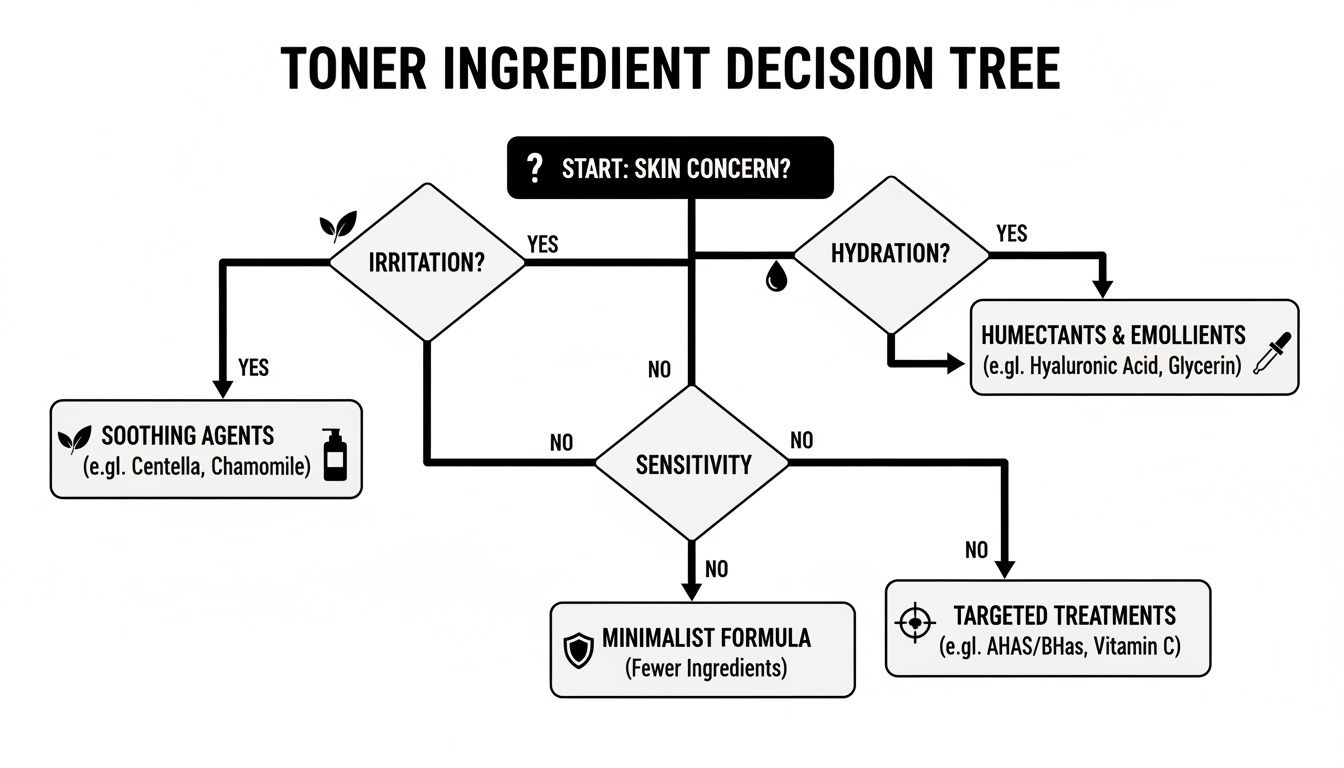
It’s a simple visual to get you started, guiding you toward calming or hydrating ingredients based on your skin's immediate signals.
For Retinol Users Needing Barrier Support
If you’re using powerful actives like retinol or prescription retinoids, your skin barrier is working overtime. These ingredients accelerate cell turnover, which is excellent for results but can also lead to dryness, flaking, and sensitivity if your barrier isn't adequately supported. A harsh toner is the last thing you need.
Your ideal toner is a gentle, reparative formula that floods the skin with calming hydration. It acts as a buffer, mitigating the potential irritation from your treatments and keeping your skin balanced and resilient.
What to look for:
- Primary Toner Type: Soothing and Hydrating Essence Toner
- Key Ingredients: Centella Asiatica (Cica) is a hero for repairing damage, Panthenol (Vitamin B5) helps strengthen the barrier, and Beta-Glucan delivers deep, lasting moisture to prevent water loss.
- Texture: Look for something with a slightly viscous, milky, or gel-like feel. It should feel comforting and create a protective layer on the skin.
For City Dwellers Fighting Environmental Dullness
Living in a city means your skin is in a constant battle with pollutants, free radicals, and other environmental stressors. This daily assault can lead to a dull, uneven complexion, clogged pores, and even premature signs of aging.
You need a multi-tasking toner that does more than just hydrate-it needs to provide antioxidant protection and help brighten that accumulated dullness. This kind of toner works to restore your skin's radiance while defending it against the very factors that make it look lackluster.
What to look for:
- Primary Toner Type: Brightening and Antioxidant-Rich Toner
- Key Ingredients: Niacinamide is brilliant for improving skin tone and strengthening the barrier. Rice Extract toners like Anua Rice 70 offer gentle brightening effects, and fermented ingredients deliver a potent dose of antioxidants.
- Texture: A watery-to-milky texture that absorbs quickly is perfect for layering under your other morning skincare and SPF.
Expert Tip: Your skin’s needs can change daily. Don't be afraid to keep more than one toner in your arsenal-a gentle hydrating one for most days, and an exfoliating or brightening one to swap in a few times a week as needed.
For Those with Dehydrated, Acne-Prone Skin
This skin type is notoriously tricky. The skin is overproducing oil, leading to breakouts, yet simultaneously lacks water, causing tightness and a compromised barrier. Using a drying, stripping toner will only exacerbate the problem by triggering even more sebum production.
The goal is to find a toner that provides deep, lightweight hydration while simultaneously calming the inflammation associated with acne. The best formulas for this skin type will balance, soothe redness, and moisturize without clogging pores.
What to look for:
- Primary Toner Type: Calming and Hydrating Toner (like the Abib Heartleaf Calming Toner)
- Key Ingredients: Heartleaf (Houttuynia Cordata) is exceptional for calming blemish-related inflammation. Snail Mucin offers oil-free hydration and repair, and low-molecular-weight Hyaluronic Acid (found in the Anua 8 Hyaluronic Acid Liposome Skin Booster) hydrates deeper layers of the skin without feeling heavy.
- Texture: Opt for a watery, refreshing texture. It should feel cooling on the skin and absorb without leaving any residue behind.
Finding Your Perfect Match on Mirai Skin
Now you can put this knowledge into practice. Instead of endlessly scrolling, you can use our filters to zero in on the exact products that fit your personalized needs. This method empowers you to shop like an expert, making an informed choice that directly tackles your unique skin goals.
Here’s how to apply this on our site:
- Start with Your Concern: Head over to our toner collection and use the "Shop by Concern" filter. Pick the main issue you identified, like ‘Dehydration,’ ‘Acne,’ or ‘Dullness.’
- Filter by Key Ingredient: Next, narrow your search by selecting a key ingredient you learned about. If you need barrier support, filter for ‘Centella Asiatica.’ For brightening, choose ‘Niacinamide’ or ‘Rice Extract.’
- Read the Descriptions: With your shortlist ready, read the product descriptions to understand the texture and full ingredient blend. This final step ensures you find the perfect formula that feels as good on your skin as it performs.
By using this targeted approach, you move beyond guesswork and start choosing the best Korean toners with purpose and confidence.
How to Maximize Your Toner's Benefits
Choosing the right toner is only half the battle; application is just as critical. The best Korean toners are loaded with potent ingredients, and your technique is what unlocks their full potential, ensuring every drop is effectively utilized.Mastering a few simple application methods can turn this fundamental step into a targeted treatment, dramatically enhancing your results. The age-old debate-hands versus cotton pads-isn't about which is superior, but about matching the method to your toner’s formula and your skin's needs at that moment.
Hands Versus Cotton Pads
Applying toner with your hands is a classic K-Beauty technique, ideal for hydrating and essence-style toners. Pour a small amount into your palms and gently press or pat it into your skin. This method minimizes product waste and uses the natural warmth of your hands to aid absorption. It's perfect for layering moisture and is incredibly gentle on sensitive skin.
Conversely, cotton pads are your best friend for exfoliating or clarifying toners. The pad provides gentle physical exfoliation, sweeping away residual impurities or dead skin cells. This ensures active ingredients like AHA or BHA are distributed evenly for a smoother, more refined texture.
You don't have to choose just one. For an advanced routine, try "toner cycling." Start with an exfoliating toner on a cotton pad, then follow up by patting in a hydrating toner with your hands to drench your skin in moisture.
Advanced Toner Techniques
Ready to elevate your routine? These advanced K-Beauty methods are designed to give your skin an intense, targeted boost of hydration and soothing care exactly where you need it.
1. The 7-Skin Method
This is the secret behind the coveted "Chok Chok," or glass-like skin. The technique involves applying up to seven thin layers of a hydrating toner, one right after the other.
- Step 1: After cleansing, pat your skin until it’s slightly damp.
- Step 2: Pour the first layer of a watery, hydrating toner into your hands and gently pat it in until it's about 80% absorbed.
- Step 3: Immediately apply the next layer, repeating the process up to seven times.
The goal is to deeply saturate the epidermis with hydration without the heavy feeling of a thick cream. Your skin should feel plump and bouncy, never sticky.
2. Toner Masking
Think of this as a quick, DIY spot treatment for dehydrated or irritated patches. It's a fantastic way to deliver a concentrated dose of calming or hydrating ingredients to specific areas, like flaky cheeks or a red T-zone.
- Step 1: Soak a few thin, separable cotton pads with a soothing or hydrating toner until they're fully saturated.
- Step 2: Place the soaked pads directly onto the areas of concern.
- Step 3: Let them sit for 10-15 minutes, just like a sheet mask. Remove the pads and gently pat in any remaining essence.
This technique is especially useful for quickly calming inflammation from a breakout or soothing a compromised skin barrier after using strong actives. By mastering these simple yet effective techniques, you can transform your daily toner application into a customized treatment and unlock the full power of the best Korean toners.
Got Questions About Korean Toners? We Have Answers.
Even after extensive research, it's normal to have questions when integrating new products into your routine. The world of skincare actives and layering can be complex, but a few key principles can provide clarity. Here are our expert answers to the most common questions we hear about using the best Korean toners.
Our goal is to ensure you feel 100% confident in your skincare choices. With the right knowledge, you can use your new toner safely, effectively, and achieve the incredible results you're after.
Can I Use a Korean Toner With Actives Like Vitamin C or Retinol?
Yes, absolutely-and you should. A well-formulated hydrating Korean toner is the perfect companion for potent actives like Vitamin C and Retinol. These ingredients can sometimes be drying or sensitizing, and a gentle, moisturizing toner is exactly what you need to buffer against potential irritation.
By reinforcing your skin barrier with hydration, a toner can make your entire routine more comfortable and effective. The secret is in the layering protocol.
Here’s the right way to do it:
- Morning Routine: After cleansing, pat your hydrating toner onto damp skin. Once it’s fully absorbed, you can proceed with your Vitamin C serum.
- Evening Routine: After cleansing, apply your hydrating toner. Allow it to sink in completely before applying your Retinol product.
One crucial rule: avoid using an exfoliating toner (with AHA or BHA) in the same routine as Retinol. This combination can lead to over-exfoliation, compromising your skin barrier and causing significant irritation.
What Is the Real Difference Between a Korean Toner and an Essence?
The line between Korean toners and essences has become increasingly blurred. Traditionally, their functions were distinct: toners were for balancing the skin’s pH post-cleanse, while essences were more concentrated formulas designed to deliver active ingredients deep into the skin.
Today, however, many of the best Korean toners are formulated like essences. They often have a slightly thicker, more viscous texture, are packed with hydrating and treatment-focused ingredients, and offer benefits far beyond simple pH balancing.
Key Insight: Don't get fixated on the label. Instead, focus on the ingredient list and the product's texture. The rise of "essence toners" confirms that the distinction is now more about marketing than a strict functional difference.
Ultimately, select a product based on your skin's needs-whether that’s the lightweight hydration of a watery formula or the deep nourishment of something more substantial.
How Do I Properly Patch Test a New Toner?
Patch testing is non-negotiable, especially for those with sensitive or reactive skin. This simple step helps identify potential allergic reactions or irritation before applying a new product to your entire face, saving you from widespread redness, breakouts, or discomfort.
Here’s a step-by-step guide to do it correctly:
- Choose a Discreet Area: Select a small, inconspicuous patch of skin, such as behind your ear, on your inner arm, or along your jawline.
- Apply a Small Amount: After cleansing and drying the area, apply a tiny amount of the new toner.
- Wait and Watch: Leave the toner on for at least 24 to 48 hours. Avoid applying other products to that specific spot to ensure an accurate test.
- Check for a Reaction: If you observe any signs of irritation-like redness, itching, burning, or vesicles-it indicates this product isn't a good match for your skin.
If the area remains calm and clear after 48 hours, you can confidently start incorporating the toner into your full facial routine.
How Long Does It Take to See Results From a Korean Toner?
The time it takes to see visible results from a Korean toner depends on its primary function and key ingredients. Skincare is a marathon, not a sprint, and consistency is paramount.
Different toner types work on different timelines.
- Hydrating Toners: With formulas rich in humectants like Hyaluronic Acid or Beta-Glucan, you'll likely feel immediate relief from tightness and a boost in softness. Expect a plumper, dewier complexion within one to two weeks of consistent daily use.
- Exfoliating Toners: If you're using a BHA toner for acne and clogged pores, it may take four to six weeks to see a significant reduction in breakouts as your skin purges and cellular turnover improves.
- Brightening Toners: When using a toner with ingredients like Niacinamide or Rice Extract to fade hyperpigmentation and even out skin tone, patience is key. It can take eight to 12 weeks of daily application to see visible improvements.
Regardless of the toner, consistent, twice-daily use is essential for achieving the best possible results.
At Mirai Skin, we’re dedicated to helping you find authentic, effective K-Beauty products that feel like they were made just for you. Explore our curated collection to discover your next holy grail.
Find the perfect Korean toner for your routine at Mirai Skin
Related Reading
- best Korean vitamin C serums
- best retinol serums
- Korean face masks