Fading dark spots isn't about finding one magic eraser. It's about a smart, consistent routine that combines proven brightening ingredients with unwavering sun protection. By layering powerful actives and committing to daily sunscreen, you can genuinely reduce hyperpigmentation for a clearer, more even-toned complexion.
A K-Beauty Guide to Fading Dark Spots for Good
If you're dealing with stubborn marks left behind by sun damage, old breakouts, or hormonal changes, you are definitely not alone. Hyperpigmentation is one of the most common skincare concerns for K-Beauty enthusiasts around the world.
Fortunately, the Korean beauty philosophy offers a powerful way forward-not through aggressive, quick-fix peels, but with a gentle, consistent approach that layers effective ingredients to restore your skin's clarity over time.
This guide is your roadmap to achieving that even-toned, healthy glow. We're skipping the generic advice to give you a method built on the science-backed principles of authentic Korean Skincare.
Why Hyperpigmentation Is Such a Big Deal Globally
The desire for clear, even skin is a huge force in the beauty industry. In fact, the global market for hyperpigmentation treatments is expected to hit USD 2.55 billion by 2034. The Asia Pacific region leads this growth, which makes sense when you consider that dark spots are a top concern for the diverse skin tones in South Korea, Japan, and India.
At the center of this movement is K-Beauty, which champions effective, non-invasive topical treatments that work. You can explore the hyperpigmentation treatment market trends in more detail here.
This guide will walk you through the world of K-Beauty, giving you the knowledge to:
- Identify exactly what kind of dark spots you have.
- Select the right powerhouse ingredients that actually deliver results.
- Build a step-by-step routine for both morning and night.
By the end of this, you won't just know what to do to fade your dark spots-you'll understand the science behind why each step works. This is about arming you with the confidence and tools to achieve lasting skin clarity. Let's get started on the path to your brightest skin yet.
What Kind of Dark Spots Are You Dealing With?
Before you start layering serums, you need to identify your target. Think of yourself as a skin detective-understanding why a dark spot appeared is the most important clue for making it disappear.
Hyperpigmentation isn't a single issue with a single solution. Different types of dark spots have different origins, and that means they respond best to different treatments. Getting this first step right is the secret to building a routine that actually delivers results instead of frustration.
Let's get familiar with the three most common culprits you'll see in the mirror.
Post-Inflammatory Hyperpigmentation (PIH)
This is that stubborn, flat mark that hangs around long after a pimple has healed. PIH is your skin's memory of some kind of trauma or inflammation-whether it's from a breakout, a scratch, an insect bite, or even over-exfoliation.
Depending on your skin tone and how deep the inflammation was, these spots can look pink, red, tan, brown, or even black. It's essentially an overproduction of melanin, your skin's natural pigment, as part of its healing process. While PIH can eventually fade on its own, it can take months, sometimes even years, without the right targeted ingredients.
Sun Spots (Solar Lentigines)
You might know these as age spots or liver spots, but they have one main cause: years and years of sun exposure. They are the visible record of all the UV damage your skin has accumulated over time.
You’ll typically find them on areas that see the most sun, like your face, the backs of your hands, shoulders, and arms. Sun spots are usually small, clearly defined, and range from a light tan to a dark brown. Unlike the aftermath of a pimple, these are tied directly to sun damage.
Key Takeaway: Daily, diligent use of a broad-spectrum sunscreen is non-negotiable for treating any dark spot. Sun exposure will make PIH, sun spots, and melasma darker, effectively erasing all of your progress.
Melasma
Melasma is more complex. It usually shows up as larger patches of discoloration, not just tiny spots. You’ll often see it in symmetrical patterns on the cheeks, forehead, upper lip (the dreaded "melasma mustache"), and the bridge of the nose.
This type is deeply connected to hormonal shifts, which is why it’s so common during pregnancy (often called the "mask of pregnancy") or for those taking hormonal birth control. Sun exposure is a major trigger that can activate it or make it worse. The global market for melasma treatments is expected to hit USD 11.54 billion by 2034, in large part because it can affect up to 40% of Asian women.
The good news? The right topical treatments can make a huge difference. Studies have shown 65% efficacy in lightening hyperpigmentation after just four months of consistent use. You can read more about hyperpigmentation market growth here.
To make it easier to tell them apart, here's a quick reference guide.
Identifying Your Type of Hyperpigmentation
| Type of Dark Spot | What It Looks Like | Common Causes |
|---|---|---|
| PIH | Small, flat spots; pink, red, brown, or black | Acne, scratches, bug bites, skin inflammation |
| Sun Spots | Small, defined spots; light tan to dark brown | Cumulative, long-term sun exposure |
| Melasma | Larger, symmetrical patches; grayish-brown | Hormonal changes, sun exposure, genetics |
Once you have a better idea of what you're dealing with, you can start choosing the right ingredients to target it effectively.
The Go-To Ingredients for Fading Dark Spots
Knowing your spot type is step one, but choosing the right ingredients is where the magic really happens. In the world of K-Beauty, ingredient lists are gospel. They’re carefully curated to deliver specific, science-backed results. It can feel overwhelming staring at a wall of serums, but it gets much easier once you know which actives to look for.
This is your cheat sheet for the powerhouse ingredients clinically proven to fight hyperpigmentation. We're cutting through the marketing noise to give you the real deal on how each one works, the best concentrations, and which type of dark spot it’s best suited for.
Vitamin C: The Antioxidant Champion
Vitamin C, often listed as L-Ascorbic Acid or one of its more stable derivatives, is a skincare superstar for good reason. Its main job in fading dark spots is neutralizing the free radicals from UV exposure-a major trigger for melanin production.
Even better, Vitamin C inhibits an enzyme called tyrosinase, which is essential for creating melanin in the first place. By blocking this enzyme, it helps stop new dark spots from forming while slowly fading the ones you already have. It’s especially great for tackling sun spots and giving your whole complexion a brighter, more even glow.
- Best For: Sun spots, general dullness, and preventing future hyperpigmentation.
- Ideal Concentration: Look for products with 10-20% L-Ascorbic Acid for the best results. If your skin is sensitive, start with a gentler derivative like Sodium Ascorbyl Phosphate or Tetrahexyldecyl Ascorbate.
- K-Beauty Tip: Always apply your Vitamin C serum in the morning, right before sunscreen. The two work synergistically to give you superior protection against the environmental damage that causes dark spots.
Niacinamide: The Multitasking Wonder
Niacinamide, a form of Vitamin B3, is a K-Beauty favorite because it’s so versatile and gentle. Unlike ingredients that stop melanin production at the source, niacinamide works by blocking the transfer of melanosomes from the pigment-producing cells (melanocytes) to your surface skin cells (keratinocytes).
Think of it this way: if melanocytes are little factories making pigment, niacinamide stops the delivery trucks from ever leaving the factory. The excess pigment never makes it to the visible surface of your skin. This makes it incredibly effective for treating PIH from acne and evening out your overall skin tone.
Key Insight: Niacinamide also strengthens your skin barrier and has anti-inflammatory properties. This makes it an amazing choice for acne-prone skin because it treats existing dark spots while helping prevent new ones from forming after a breakout.
AHAs and BHAs: The Exfoliating Acids
To fade the dark spots you can see, you need to accelerate your skin's natural desquamation process. This is where chemical exfoliants like Alpha Hydroxy Acids (AHAs) and Beta Hydroxy Acids (BHAs) shine.
- AHAs (like Glycolic and Lactic Acid): These are water-soluble, so they work on the skin’s surface. They dissolve the "glue" holding dead, pigmented skin cells together, helping them shed faster to reveal the brighter, more even skin underneath. Glycolic acid is a workhorse for stubborn sun spots.
- BHAs (like Salicylic Acid): This one is oil-soluble, meaning it can get deeper into your pores. Famous for fighting acne, salicylic acid is also fantastic for fading the red or brown marks left behind-that pesky post-inflammatory hyperpigmentation (PIH).
You’ll often find K-Beauty formulas that combine both AHAs and BHAs to tackle discoloration from multiple angles for a more well-rounded approach.
Retinoids: The Gold Standard
From gentle over-the-counter retinol to prescription-strength tretinoin, retinoids are considered the gold standard for a reason. They work by putting cellular turnover into overdrive. This process pushes old, discolored cells to the surface so they can be sloughed off, making way for fresh, healthy cells.
This rapid renewal is highly effective against all kinds of hyperpigmentation, from stubborn PIH and sun spots to the more complex patterns of melasma. As a bonus, they also boost collagen, which means smoother, firmer skin. If you’re new to retinoids, start slow with a low concentration (0.1% to 0.3% for retinol) just a few nights a week to allow your skin to acclimatize.
Tranexamic Acid and Arbutin: The Targeted Specialists
While the ingredients above are great all-rounders, some actives are specialists that target the melanin pathway with laser-like precision.
The global demand for effective topical treatments has skyrocketed, especially in the Asia Pacific region, fueling research into powerful yet gentle ingredients. For instance, studies on topical tranexamic acid, a hero in many K-Beauty formulas, have shown it can reduce dark spots by 49% in just 12 weeks without significant irritation. It's no wonder it's been adopted so quickly worldwide. You can discover more about the growing hyperpigmentation treatment market.
Here's a closer look at how these specialists work:
- Tranexamic Acid: This ingredient is particularly good at calming the skin and interrupting the inflammatory signals that trigger melanin production, especially after sun exposure. It's an excellent choice for stubborn melasma and PIH.
- Alpha-Arbutin: A much gentler and safer derivative of hydroquinone, Alpha-Arbutin works by slowly releasing its active components to inhibit that tyrosinase enzyme we talked about earlier. It effectively fades dark spots with a much lower risk of irritation.
Once you understand what each of these powerhouse ingredients does, you can strategically build a routine with products from Mirai Skin's curated K-Beauty collection that precisely targets your specific type of hyperpigmentation.
How to Build Your K-Beauty Dark Spot Routine
Knowing which ingredients to look for is half the battle won. But the real secret to fading dark spots for good lies in how you build your routine. A consistent morning and evening ritual is the framework that lets those powerhouse actives perform, transforming your skin from the inside out.
This isn’t about slavishly following a rigid, 10-step K-Beauty process. It’s about understanding the core philosophy-cleanse, treat, hydrate, protect-and then arranging your products in an order that maximizes their efficacy without causing irritation. Let's map out your personal blueprint.
The most effective routines tackle hyperpigmentation from three angles at once: blocking new melanin, fading existing spots, and renewing skin cells.
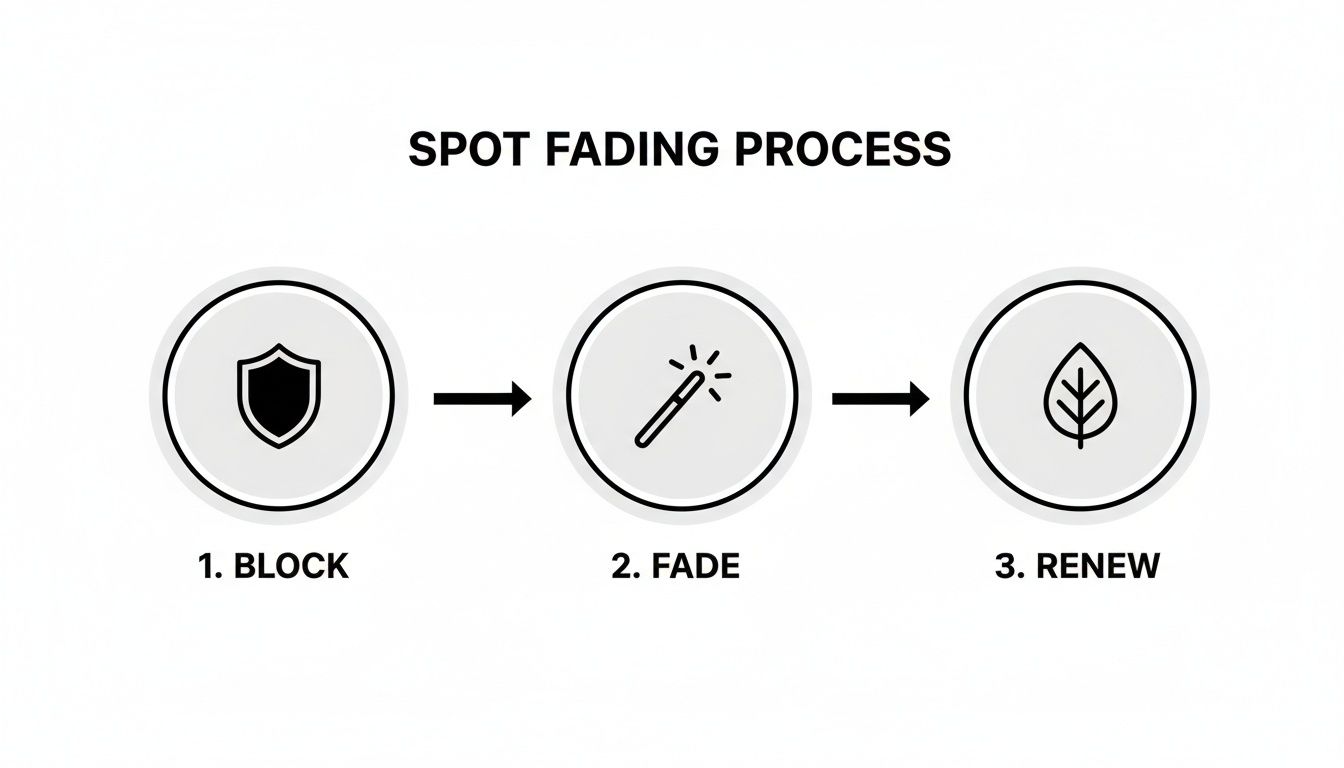
Think of it this way: a truly great routine doesn't just treat the spots you can see. It actively works to stop new ones from forming while boosting your overall skin health.
Your Morning Routine for Protection and Prevention
Your morning routine has two main jobs: shield your skin from the daily onslaught of UV rays and pollution that cause dark spots, and apply antioxidants to help fade the ones you already have.
-
Gentle Cleanse: Start with a mild, low-pH cleanser. In the morning, you’re just rinsing off last night’s products and a little oil. Anything harsh will strip your skin barrier, which is counterproductive.
-
Prep with Toner: This is a K-Beauty non-negotiable. A hydrating toner does more than just add moisture back after cleansing; it preps your skin to better absorb the serums that come next. It's the difference between trying to clean a counter with a dry sponge versus a damp one-the damp one just works better.
-
Apply Your Antioxidant Serum (Vitamin C): This is your hero step for the AM. A good Vitamin C serum, applied to dry skin, acts as a shield against free radical damage all day long. Bonus: it actually boosts the efficacy of your sunscreen.
-
Moisturize: Follow up with a moisturizer that works for your skin type. This step is crucial for locking in all the goodness from your serum and keeping your skin barrier healthy. Yes, even oily skin needs a lightweight lotion to stay balanced.
-
Sunscreen (The Non-Negotiable): This is, without a doubt, the most important step for fading dark spots. You need a broad-spectrum sunscreen with at least SPF 30 every single day. Rain, shine, indoors-it doesn't matter. Without it, you’re undoing all your hard work.
Insider Tip: Give your Vitamin C serum a minute or two to fully absorb before you move on to moisturizer and sunscreen. This simple pause ensures each product can perform optimally without being diluted by the next layer.
Your Evening Routine for Repair and Renewal
Nighttime is when your skin switches into repair mode, making it the perfect time to bring out the heavy-hitting actives. This is when you’ll use powerful ingredients like exfoliants and retinoids, since they can work without having to battle UV rays.
The foundation of any solid PM routine is the K-Beauty signature: the double cleanse. This two-part process is brilliant because it removes every last trace of makeup, sunscreen, and city grime, creating a perfectly clean slate for your treatments.
-
First, an Oil Cleanser: Start with an oil-based cleanser or a cleansing balm. Massage it onto dry skin to dissolve oil-based impurities like stubborn SPF, makeup, and your own excess sebum.
-
Second, a Water-Based Cleanser: Follow up with a gentle foam or gel cleanser. This washes away any leftover oil residue plus all the water-based grime, like sweat and dirt.
The Treatment Phase: How to Layer Your Actives
Once you've double-cleansed and toned, it’s time for the "treat" steps. This is where you’ll apply your most concentrated, spot-fading ingredients.
The golden rule of layering is simple: go from thinnest to thickest consistency. This usually means watery serums come before richer creams or oils. But when you're using multiple active ingredients, the order and frequency become critical for avoiding irritation.
Here’s a simple guide for slotting your actives into your routine:
- Exfoliating Acids (AHAs/BHAs): These should only be used 2-3 times per week. Apply them right after cleansing and toning, onto dry skin. Let them sit for a few minutes to work before you apply anything else.
- Retinoids: Apply your retinol after any hydrating serums. If you're new, start slow with just 1-2 nights a week. A great trick is the "sandwich method": apply a thin layer of moisturizer, then your retinoid, then another layer of moisturizer to buffer potential irritation.
- Niacinamide, Tranexamic Acid, Arbutin: These are generally gentle enough to be used nightly. Layer them in after your exfoliants (on non-exfoliating nights) but before your retinoid or final moisturizer.
Still not sure it's worth the effort? A consumer perception test on a spot treatment with Salicylic Acid showed that 95% of users saw a reduction in post-breakout marks after only four weeks. Consistency with the right actives in the right order really does pay off. You can find a whole range of these targeted treatments in the Mirai Skin serums collection to start building your routine.
Advanced Tactics to Accelerate Your Results
Once you've mastered the basics of your routine, you can start weaving in more advanced strategies to really see a difference. This is where you move from just treating dark spots to actively outsmarting them. It’s all about making your products work smarter, not harder, and creating a resilient environment where new hyperpigmentation struggles to form.
Think of it as adding boosters to an already solid foundation. These tactics are designed to speed up the fading process while keeping your skin barrier strong and healthy-a core tenet of K-Beauty philosophy. Let's explore how you can safely level up your approach.
Strategic Ingredient Combinations
Pairing the right actives can create a powerful synergistic effect, where the ingredients work together to deliver results far greater than the sum of their parts. One of the most effective and popular combinations is using an antioxidant by day and a cell-turnover agent by night.
-
Morning: Apply a Vitamin C serum to shield your skin from the environmental aggressors that trigger melanin production. It essentially acts as a bodyguard, neutralizing free radicals before they can cause damage.
-
Evening: Use a retinoid to speed up skin cell turnover. This helps push pigmented cells to the surface so they can be shed more quickly, revealing the clearer, more even-toned skin underneath.
This simple day-and-night strategy tackles hyperpigmentation from both a preventative and a corrective angle. It's one of the most effective ways to fade dark spots quickly and safely.
The Power of Skin Cycling
"Skin cycling" is a modern, K-Beauty-friendly concept that perfectly balances potent actives with crucial recovery time. Instead of bombarding your skin with exfoliants and retinoids every single night, you create a schedule that gives your skin barrier a chance to repair itself. This is key, as it prevents the irritation and inflammation that can ironically lead to more hyperpigmentation.
A typical four-night cycle looks something like this:
- Night 1 Exfoliation: Use your chosen AHA or BHA product to slough off dead, pigmented skin cells.
- Night 2 Retinoid: Apply your retinol or other retinoid to boost cell renewal from within.
- Nights 3 & 4 Recovery: Give your skin a break. Focus only on hydration and nourishment with gentle, barrier-supporting ingredients like ceramides, snail mucin, or hyaluronic acid. Then, repeat the cycle.
This method ensures you get all the spot-fading benefits of your powerful actives without compromising your skin's health. Remember, a healthy skin barrier is less prone to inflammation, which is a major trigger for post-inflammatory hyperpigmentation.
Understanding Sunscreen SPF and PA+ Ratings
I know we sound like a broken record, but it has to be said: sunscreen is the single most important product in your routine for fading dark spots. Without it, UV exposure will just keep stimulating melanin production, darkening existing spots and creating new ones. You'll be undoing all your hard work.
But not all sunscreens are created equal, especially when you're fighting hyperpigmentation.
-
SPF (Sun Protection Factor): This number primarily measures protection against UVB rays, the kind that cause sunburn. An SPF of 30 or higher is the recommended minimum for daily use.
-
PA+ Rating: This system, widely used in Korean and Japanese sunscreens, measures protection against UVA rays. These are the rays that penetrate deeper into the skin, causing premature aging and, critically, triggering the melanin production that leads to dark spots. The more plus signs (from PA+ to PA++++), the higher the protection.
For anyone serious about fading dark spots, a sunscreen with SPF 50+ and a PA++++ rating is the gold standard. It provides the highest level of defense against both types of damaging UV rays.
Setting Realistic Expectations for Fading Dark Spots
Finally, the most underrated tool in your skincare arsenal is patience. Hyperpigmentation didn't appear overnight, and it won't disappear overnight either. The process is a marathon, not a sprint.
Generally, you can expect to see initial improvements in 4 to 8 weeks with consistent use of a targeted routine. However, for deeper or more stubborn spots, it can take 6 to 12 months to see significant fading.
The key is consistency. Stick with your routine, protect your skin from the sun without fail, and trust the process. Your dedication will pay off with a clearer, more radiant complexion.
Common Questions About Fading Dark spots
Jumping into the world of skincare actives can feel a little intimidating. When you're dealing with powerful ingredients to fade dark spots, it's totally normal to have questions pop up. Am I layering these right? Is this reaction normal?
Let’s clear up some of the most common concerns. Think of this as your go-to FAQ for achieving that clear, even-toned complexion you're working towards.
Can I Combine Vitamin C and Niacinamide in the Same Routine?
This is probably one of the biggest myths still circulating in skincare, and it comes from outdated research. The short answer? Yes, you absolutely can. The old fear that they cancel each other out or cause irritation just doesn't hold up with today's advanced, stable formulas.
In fact, they make a fantastic team. Vitamin C is your powerhouse antioxidant that helps inhibit pigment production, while Niacinamide works to prevent that pigment from ever reaching your skin's surface. Plus, it’s a champ at strengthening your skin barrier.
You can easily layer them-just apply Vitamin C to clean, dry skin first. Or, if you prefer, split them up: Vitamin C in the morning for that antioxidant shield and Niacinamide at night.
What Should I Do If My Skin Gets Irritated?
Redness, stinging, or peeling skin is your cue to pull back. It’s a clear sign that your skin barrier is compromised, which usually happens when you introduce too many new actives at once or use a concentration that’s too strong for your skin.
If this happens, stop all your actives immediately. That means no acids, no retinoids, and no Vitamin C for a little while. Pare your routine back to the bare essentials for a week or two to let your skin heal.
- Cleanse: Stick to a gentle, low-pH, hydrating cleanser.
- Hydrate: A soothing toner or essence with ingredients like Centella Asiatica (Cica) or Snail Mucin will be your best friend.
- Moisturize: Grab a barrier-repair cream packed with ceramides, panthenol, or squalane.
- Protect: Don't even think about skipping sunscreen. A damaged barrier is extra vulnerable to UV damage.
Once your skin feels calm and happy again, you can slowly reintroduce one active at a time, starting with a lower frequency to see how your skin handles it.
Does a Higher Price Tag Mean Better Results?
Not at all. A high price is often more about branding, luxurious packaging, and a big marketing budget than the actual effectiveness of what's inside the bottle. Sure, some luxury products might contain unique ingredients or sophisticated delivery systems, but plenty of affordable K-Beauty brands offer incredibly effective, science-backed formulas.
Key Takeaway: Focus on the ingredient list, not the price. A well-formulated serum with 5% Niacinamide or 15% Vitamin C from a reputable brand can deliver fantastic results without emptying your wallet. Look for proven actives at effective concentrations.
Why Are My Dark Spots Getting Darker at First?
Okay, this can be super alarming to see, but try not to panic. It's often a completely normal-and temporary-part of the process, especially when you start using retinoids or exfoliating acids. These ingredients work by accelerating skin cell turnover, which pushes all those pigmented cells up to the surface more quickly.
Basically, the melanin that was hiding in the deeper layers of your skin is being brought into the spotlight before it gets sloughed away. This can make spots look darker for a short while. As long as you're being diligent with your sunscreen and not experiencing any irritation, trust the process. This phase will pass as your skin continues its renewal cycle, revealing a much clearer complexion underneath.
Your journey to fading dark spots is a marathon, not a sprint, and having the right knowledge makes all the difference. Equip your routine with authentic, results-driven formulas from Mirai Skin. Explore our curated collection of K-Beauty essentials and start your path to radiant skin today.